GTA VI, or the Allegory of Happiness in Waiting
In brief
The wait for GTA VI has made room for shared plans, memories and imagined freedom. A personal reflection on the pleasure of anticipation, the desires that survive satire and the power of a familiar cultural name.
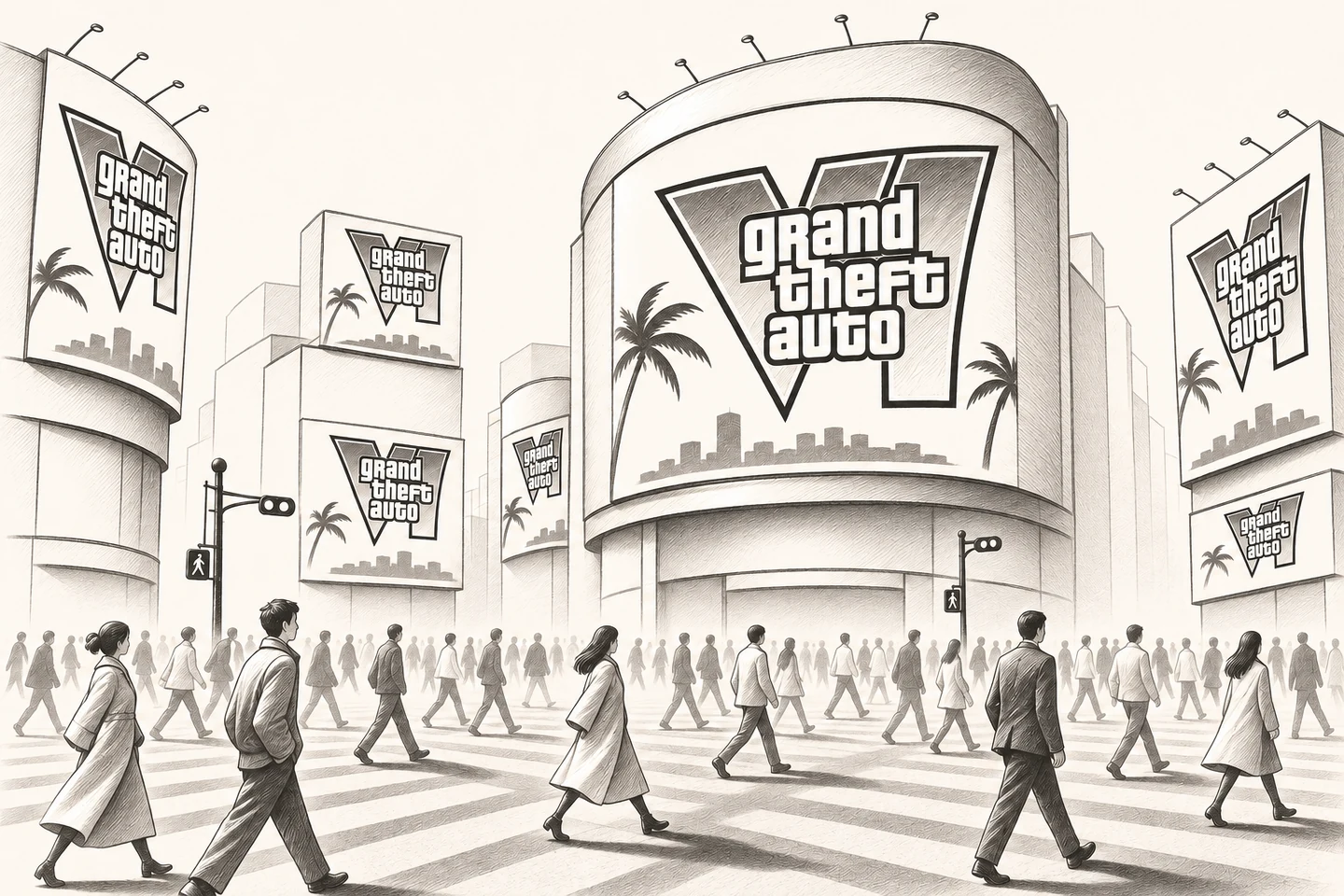
Rockstar set November 19, 2026 for GTA VI. For someone who played GTA V when it arrived in September 2013, more than thirteen years have passed. An eighteen-year-old then is now in their thirties, possibly trying to fit the new game around responsibilities they hadn’t imagined when they bought the previous one.
An evening to themselves might take some arranging.
I can understand the pleasure of having a date to work towards. Work and family commitments make it easy to postpone seeing friends, particularly when meeting properly would require a journey. A game gives a conversation somewhere to begin. You can send a trailer to someone you haven’t spoken to for months without having to explain the silence first.
Younger players will bring different expectations. Some will be discovering a series they’ve heard discussed for years. Among older players, excitement about a new game may come mixed with memories of the people who were around for the last one. The same announcement can mean quite different things to the people receiving it.
The pleasure before the purchase
A trailer lasts a few minutes. Examining it can occupy an evening. Pause at a street sign, compare a location with an earlier image, disagree about a character’s intentions. Someone makes a video about the theory, and the comments supply enough objections for another video.
During a long wait, speculation gives a community something to do. Knowing the references helps you join in. Even an implausible theory can be enjoyable to discuss with people who understand why you noticed the detail in the first place.
Rockstar gets considerable promotional work from this activity. The platforms benefit from the time people spend watching, and creators have a reason to keep the conversation moving. A fan can understand those incentives perfectly well and continue enjoying the discussion. I’d give them that credit.
Pascal’s account of diversion in the Pensées is harder to dismiss. He describes people becoming so occupied by a pursuit that its apparent reward would scarcely satisfy them if handed over without the chase. Elsewhere, he examines our habit of placing happiness in the future. We spend the present preparing to enjoy ourselves later.
GTA VI has had to compete with versions of itself that existed only in people’s expectations. Those imagined games could accommodate incompatible wishes. They also came with ideal circumstances for playing them. In anticipation, you have the time, your friends are available and nobody is too tired to enjoy the evening.
A finished game enters an ordinary household.
There’s pleasure in looking forward to something, and I’d be sorry to lose it. A plan can make a difficult week easier. I become more uneasy when buying something starts to feel like the most reliable way to give the coming months a little promise. We should still be able to arrange an enjoyable evening without waiting for a company to announce its release date.
Returning to a familiar series brings another expectation that its makers cannot fulfil. A game may recall a summer when money was short but time was plentiful. Someone might remember the room they played in more clearly than the missions. A new version can stir those memories without restoring the circumstances that made them possible. The people who shared them have aged too, and may have equally complicated calendars.
An evening without instructions
The freedom to ignore an objective has an obvious appeal after a day spent following instructions. An open world lets you take a different road or spend time doing something with no useful result. You can decide when to stop. That seems sufficient reason to enjoy it, without assuming dissatisfaction with the rest of your life.
The attraction of breaking rules takes us closer to Plato. In the Republic, Glaucon tells Socrates about the ring of Gyges, which makes its wearer invisible. He uses the story to challenge the idea that people value justice for its own sake. Given the ability to escape discovery and punishment, would they continue behaving justly?
A game gives that thought a setting in which fictional transgression has no real victim. Choosing to misbehave there tells us little, by itself, about how a player would treat an actual person. The permission can still be pleasurable. You can experiment, accept the game’s consequences and eventually leave the whole system.
Nietzsche’s suggestion that we give style to our character, in The Gay Science, involves sustained work on the person we already are. Strengths and weaknesses have to be shaped over time. Trying a fictional identity for an evening asks for a much shorter commitment. It can be enjoyable without doing that larger work for us.
I’m reluctant to require personal improvement from every hour of leisure. Adults already have enough activities whose value gets measured by their results. Protecting an evening for play is a reasonable ambition. A major release can make that easier to explain to other people, although it’s curious that the date on a product should sometimes give us permission to claim our own time.
The car is still desirable
GTA makes fun of a society absorbed by wealth, status and consumption, while letting players enjoy acquiring their rewards. A character can be ridiculous and still drive a car you would like to own. The satire leaves that desire available.
Luxury offers a familiar comparison. Someone can explain a brand’s marketing with considerable accuracy and still want the bag. Understanding how desire has been encouraged doesn’t necessarily diminish the pleasure of possessing the object.
I wouldn’t assume that laughing at an aspiration frees us from it. GTA can make its world’s excesses look absurd and enjoyable within the same scene. A player might leave with a sharper sense of their ridiculousness. Another could spend the evening happily pursuing them. Satire gives an audience something to work with, and its effect remains uncertain.
Adorno and Horkheimer described a culture industry that promises novelty while relying on familiar formulas and avoiding untested risks. An established name helps a company secure attention before anyone encounters the new work. For the buyer, that reputation offers some reason to commit money and time.
A series can deserve its following and still make life difficult for unfamiliar work. Years of recognition help each announcement travel. A new creation has to persuade people to care enough to look. Our understandable preference for a trusted name gives its owner considerable influence over what we anticipate next.
I’d keep some expectations for GTA VI fairly modest. An enjoyable evening is a reasonable hope. Recovering an earlier period of your life asks a great deal of a game. If an old friend belongs in the picture, I’d send the message while making the plans. They may need more notice than the download.
Sources & references
- Rockstar Games: GTA V release date, September 17, 2013
- Rockstar Games: GTA VI regional release times, November 19, 2026
- Blaise Pascal: Pensées, Brunschvicg fragments 139 and 172
- Plato: Republic, Book II, the ring of Gyges, 359c–360d
- Friedrich Nietzsche: The Gay Science, section 290
- Theodor W. Adorno and Max Horkheimer: The Culture Industry, from Dialectic of Enlightenment