What Is Oud?
In brief
Oud is fragrant, resin-rich wood produced by certain Asian trees. Also called agarwood, it is heated as incense or distilled into oil for perfume. Its smell can be recreated with other ingredients. A perfume’s name alone won’t tell you whether it contains natural oud.
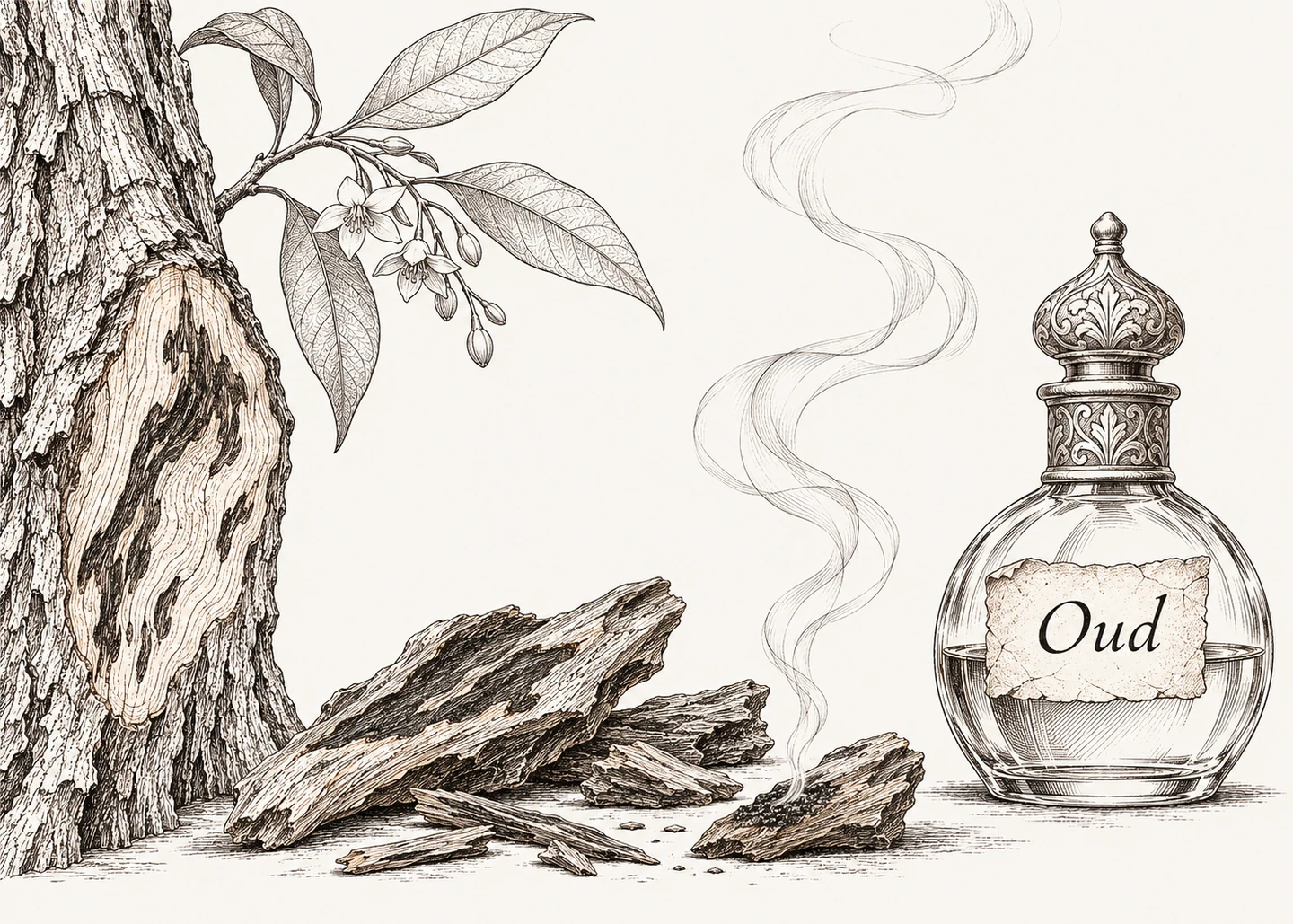
Inside the tree
A rose gives you something to picture. Oud is harder. Before thinking about a perfume bottle, I need to imagine a tree cut open.
Much of its wood may be pale. Darker patches mark the places where aromatic resin has accumulated. Trees belonging to Aquilaria and Gyrinops can produce this resin in response to injury and biological stress, including fungal infection. The resinous portions are sought as agarwood. Their quantity and quality vary from tree to tree.
A fragrance beginning in a tree’s effort to protect itself has a certain poetry. The dark streaks make me think of a scar you can smell.
Producers separate the scented material from the surrounding wood. Distillation with water or steam yields agarwood oil. Chips can also be heated for incense, a practice with a long history across Asia and the Middle East. Oud already belonged to people’s homes and ceremonies long before Western perfume houses put its name on a bottle.
Finding the smell
“Woody” doesn’t help me much on its own. There is quite a distance between a pencil shaving and a piece of sandalwood.
PROSEA’s botanical reference describes agarwood oil as balsamic and woody, with a sweetness resembling sandalwood. The description of dsm-firmenich’s Black Agar reconstruction includes leather and amber. These give us some bearings, though I would still want someone to put a sample under my nose.
The perfume introduces other smells. Tom Ford describes Oud Wood with cardamom, sandalwood and vetiver alongside its oud notes. The brand calls those notes a blend evoking the material. That wording describes an intended effect without disclosing the complete formula.
Discovering oud through a finished fragrance means meeting it in company. I’d be careful about blaming the wood for everything I disliked.
What went into the bottle?
A perfumer can build an oud accord using other ingredients. Suppliers sell prepared bases for this purpose. Black Agar, for example, is classified by dsm-firmenich as a synthetic base.
I’m comfortable with a reconstruction. My patience wears thinner when a sales description spends a paragraph on the extraordinary cost of agarwood and leaves me guessing whether the perfume contains any natural oil.
The question seems reasonable enough to ask at the counter. Does this fragrance use natural agarwood oil? If so, where does it come from?
Sourcing deserves attention. Excessive harvesting has put wild trees under pressure. ITTO and CITES have examined cultivation and techniques for inducing resin formation to help reduce dependence on wild populations.
I’d welcome a few details about the grower or distiller. Even an explanation of how the wood was harvested would give me something to work with. Before the scented chip, before the oil, there was a tree with leaves moving in the air. I’d like the house selling the perfume to know something about it.