Friday Column #4: When You Wear a Copy, What Do You Call Your Perfume?
In brief
Perfumes sold as “inspired by” promise a familiar scent for less money. I understand the appeal. They also make me wonder how much of the original survives in our desire, right down to the name we give when someone asks what we are wearing.
We can spend a great deal of time wanting something we don’t own. A perfume, a house, a life imagined elsewhere. Sometimes the anticipation occupies us more than the object does once we have bought it. I see a certain beauty in our ability to dream beyond our means. It can also become exhausting.
Desire makes us search, create and change our habits. It brings some fairly ordinary frustrations too. We check the price of a bottle, put down the tester and leave with the scent on our wrist. A few hours later, an advertisement offers an “inspiration” of the same perfume for considerably less. The timing is good.
Buying the alternative may be a perfectly reasonable decision. I’m less convinced that the original’s name disappears from the purchase. It helped us identify the smell we wanted. It may also suggest a house we admire, someone we would like to resemble, or the pleasure of finally buying something that had seemed beyond reach.
Veblen examined consumption as a way of displaying social position. Bourdieu explored how our tastes bear the marks of our background and help establish social distinctions. Perfume complicates the picture. The bottle usually stays at home. In the street or the office, the smell travels without its label.
Then someone comes closer and asks what we are wearing. We might name the product we bought, name the fragrance it resembles, or explain the bargain we found. I would be curious to hear the answer. It might reveal something about the place the original keeps in our desire, even after we have bought its copy.
Nothing comes from nothing
We like to give creation an almost divine origin. A muse leans over a shoulder, a revelation arrives in a dream, an idea appears without warning. These images have their charm. They leave the years of learning, observation and work on other people’s ideas somewhere in the shadows.
Newton knew Kepler’s laws of planetary motion. Leonardo da Vinci read Francesco di Giorgio Martini’s treatise on architecture and machines, adding his own notes to its pages. I like that detail. In the margins of a book, we find a man at work, paying close attention to another man’s thinking.
Perfumery has its own lines of descent. When Ernest Beaux composed Chanel N°5, launched in 1921, aldehydes were already among the materials available to perfumers. Houbigant’s Quelques Fleurs had used them before him. Their earlier appearance hardly explains Beaux’s composition, its proportions or the result he achieved.
Yves Saint Laurent drew on menswear for his safari jacket, introduced on his runway in 1967. In 1965, his dresses had already carried Mondrian’s compositions onto moving bodies. The source remained recognisable. Turning it into clothing still required decisions about cutting, construction and how those lines and colours would be worn.
These examples make me cautious about the word “inspiration”. To my mind, it asks us to look closely at the work of those who came before us. We study their choices, try to understand how an idea took shape, then attempt something different with it. The contribution might be considerable. It might also lie in a tiny adjustment that opens up a new possibility.
Inspiration allows an innovation to belong to a history, sometimes to a particular movement, while acknowledging a debt to others. That relationship deserves to be recognised. It also invites us to examine the work done since.
Using “inspiration” to describe a copy brushes aside that expectation. The word becomes convenient, almost flattering, when the intention is to reproduce the likeness of an existing result.
Counterfeiting, copying and inspiration
Counterfeiting involves the infringement of an intellectual property right. In perfume, this might concern a brand name, a logo or a protected bottle design reproduced without permission. A fake sold as genuine is an obvious example. A product sold under its own name can also infringe protected rights. The legal assessment depends on what has been reproduced and the protection it enjoys.
Copying means reproducing something that already exists. The word describes an approach that seeks resemblance in appearance, smell or effect. A perfume brand might try to reproduce the trail of a well-known fragrance while using its own bottle. That resemblance alone does not establish counterfeiting. Nor does it guarantee that every practice used to sell the product is lawful.
Inspiration involves an influence developed into work of one’s own. A perfumer might return to an old composition, linger over its rose and wood accord, then explore a balance that takes it somewhere else. For me, the word carries an expectation of that work and an acknowledgement of its sources.
In France, a perfume’s smell falls outside copyright protection. The Cour de cassation reaffirmed this position in 2013: in the court’s view, a fragrance lacks a form that can be identified and communicated with sufficient precision. For a profession that sometimes spends years developing a composition, the legal difficulty is rather perplexing.
This absence of protection leaves room for very close resemblances. “Inspiration” can cover approaches we might readily describe as copying. Legal remedies remain possible, particularly where the circumstances establish unfair competition or parasitic conduct. How the perfume is marketed, and how it benefits from another house’s work, then become part of the assessment.
The dispute between Thierry Mugler Parfums and Molinard deserves a careful look at the dates. Angel launched in 1992. Nirmala dates back to 1955, but went through several reformulations. The dispute concerned the version brought to market in 1993, after Angel’s arrival. That distinction matters. The original Nirmala could hardly have imitated a perfume created almost forty years later.
On 24 September 1999, the Paris Commercial Court ruled against Molinard for unfair competition and parasitic conduct. It recognised the freedom to explore gourmand notes, while finding fault with this version of Nirmala’s proximity to Angel and the attempt to benefit from its success. Molinard appealed. The houses subsequently reached an agreement ending the dispute, accompanied by a statement acknowledging Molinard’s good faith. That later development belongs in the account too.
Wearing an “inspiration”
An advertisement shows a familiar bottle, then offers to recreate its smell for much less. The comparison takes seconds. We already know the name, sometimes the perfume itself. The difference in price gives us a reason to keep watching.
Social media suits this presentation. Comparison videos and “dupe” recommendations have become part of perfume content. Spate, which analyses online searches and social conversations, has identified queries pairing fragrance names with the search for a cheaper alternative. That tells us something about how people search. Their individual reasons for buying would require a separate investigation.
I understand liking a smell and refusing its price. A reasonable expense for one person may be beyond another’s means. Someone might buy an alternative out of curiosity, to wear perfume more often, or because they prefer it after trying it. Assuming that all these buyers want to deceive others would be unfair.
The sales promise still deserves attention. Saying one perfume resembles another leaves quite a lot unexplained. Does the resemblance last through the opening minutes? Is it still there several hours later? A video lets us see the bottles and hear an opinion. Comparing the smells will always require smelling them.
I would also like to know the circumstances of the recommendation: a gifted product, a paid partnership, a commission on sales. Those relationships do not invalidate an opinion. They help me decide how much weight to give it.
The original keeps circulating
Baccarat Rouge 540 and Louis Vuitton’s perfumes bring the question into sharper focus. Offers explicitly name them as references, including on product pages. A customer can buy a different bottle while making the choice through the original’s name.
Baccarat Rouge 540 has a specific history. Francis Kurkdjian created it in 2014 for the 250th anniversary of the Baccarat crystal house. That origin belongs to the creation, even when an “inspiration” advertisement retains only its name and the promise of a similar smell. The name is enough to establish the connection. It carries something the seller of the alternative did not have to build.
Louis Vuitton’s Imagination also serves as a reference for fragrances sold as alternatives. On its official page, Jacques Cavallier Belletrud speaks of the five years he spent pursuing his idea around an amber note. A cheaper offer can use the name to give a buyer an immediate expectation of the smell. It may also awaken a desire for Vuitton, its objects and whatever place the house occupies in that customer’s imagination. That second possibility seems plausible to me. It cannot tell us what motivates every buyer.
I wonder, then, which part of the story these offers keep alive. The creation itself risks being reduced to a few notes and a claimed percentage of resemblance. The perfume’s reputation continues to travel. Every comparison reminds us that an original exists and is considered worth measuring another product against.
That may sustain its recognition. It does not follow that the house gains sales. Some buyers will be satisfied with the alternative. Others may eventually want the perfume that first gave them a reference.
When we wear that cheaper version and someone asks about our perfume, which name do we give? The one printed on the bottle we bought, Baccarat Rouge 540, or Imagination? If the original’s name comes to us first, it has kept a place in our purchase. I would like to understand what that place means.
Being human, and the intimate art of desire
In a world of abundance and immediacy, I wonder how much room we still leave for desire. The hope of one day owning an exceptional object, having a rare experience, or creating something whose form we cannot yet imagine. Waiting can be frustrating. It also gives our dreams a direction.
Technology, artificial intelligence, 3D printing and knowledge available online seem to bring the inaccessible closer every day. Money opens more doors still. If we could obtain everything we wanted, what would become of the part of us that hopes, imagines and searches?
I like to imagine the gods of Olympus watching human beings with a certain envy. We have so little time, limited means and so much beyond our grasp. Yet a desire can be enough to fill a life. I also imagine those gods weary of their power, tearing one another apart to occupy an eternity that has grown too long. In our efforts to make everything possible and immediate, perhaps we risk becoming a little like them.
Without desire, how much room would remain for belief and hope? Are we heading towards that Olympian boredom, condemned to find a fresh longing as soon as the last one has been satisfied? I would like to pause a little earlier. To look at what I am about to buy and understand the value I give it.
The price of a bottle of Baccarat Rouge 540 pays for a composition, a bottle, communication, distribution and margins. A buyer may also seek a tangible connection with a story, a perfumer’s work and a particular pursuit of beauty. None of this automatically justifies the asking price. It can, however, belong to the pleasure of owning the original.
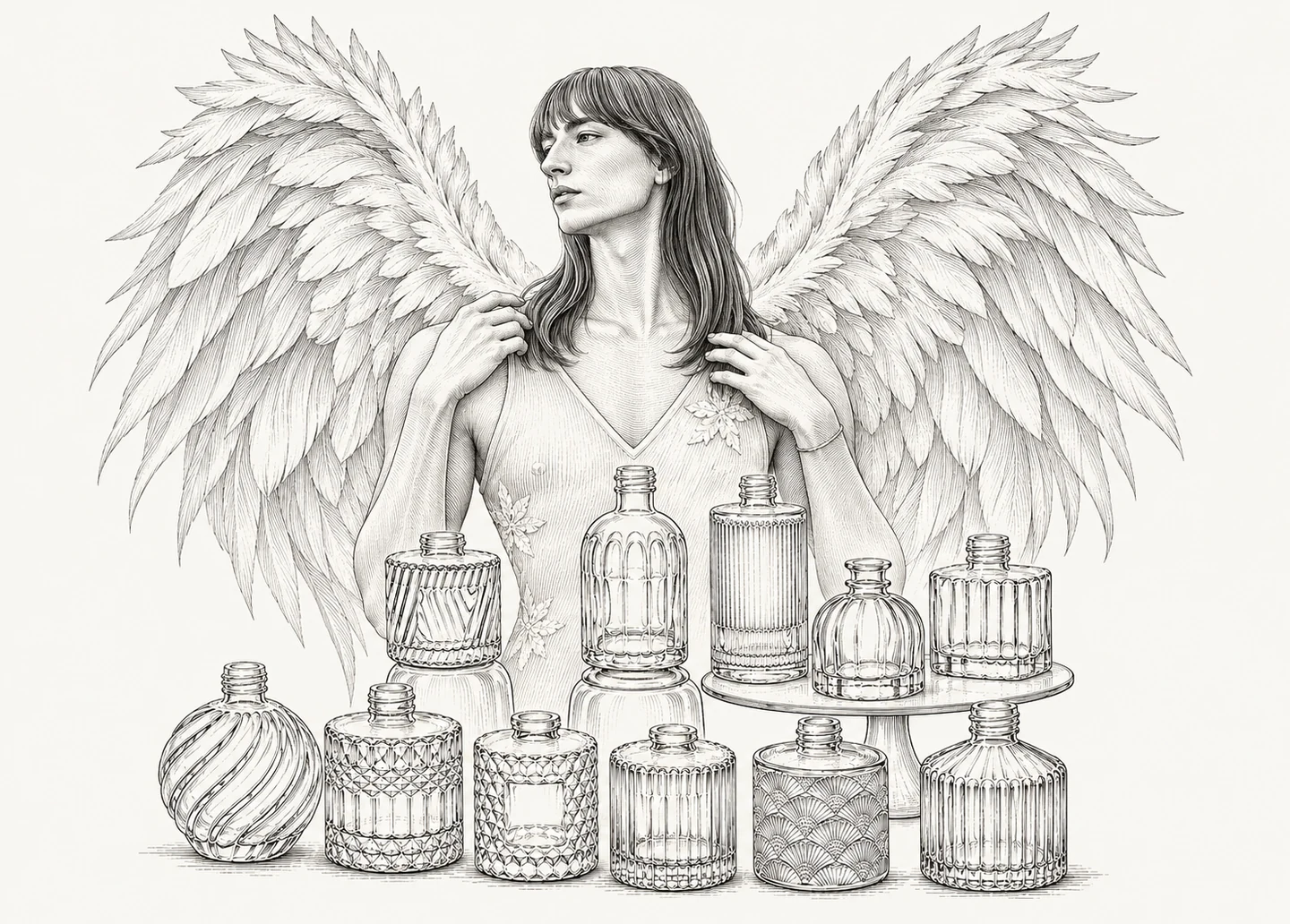
Devoting so much effort to a smell is almost unreasonable. I find that persistence touching. Searching for the missing accord, returning to a formula, continuing because you believe you can come closer to what you imagine. There is something of reaching towards the divine in it. With our borrowed time and human means, we have to accept that some things will remain beyond us, or risk singeing our wings.
Sources & references
- Thorstein Veblen: The Theory of the Leisure Class
- Pierre Bourdieu: La Distinction
- University of California Press: The Key to Newton’s Dynamics
- Museo Galileo: Francesco di Giorgio Martini’s treatise annotated by Leonardo da Vinci
- CHANEL: The 1920s and the creation of N°5
- University of Bristol: Aldehydes and Chanel N°5
- Musée Yves Saint Laurent Paris: The first safari jacket
- Musée Yves Saint Laurent Paris: The Mondrian revolution
- INPI: The definition of counterfeiting
- French Customs: Counterfeit perfumes and dupes
- Cour de cassation: Judgment of 10 December 2013 on fragrance copyright
- Jean Calvo: Thierry Mugler Parfums v. Molinard, judgment of 24 September 1999
- Paris Tribunal de grande instance: Judgment of 12 March 2007 describing the settlement
- Molinard: The history of Nirmala
- Fragrantica: Nirmala’s formulations in 1955, 1993 and 2003
- Mugler: Angel’s launch in 1992
- Spate: Search and social conversations about fragrance
- Maison Francis Kurkdjian: The origins of Baccarat Rouge 540
- Louis Vuitton: Imagination and Jacques Cavallier Belletrud