Fashion
Thierry Mugler: The Anatomy of Power
In brief
Thierry Mugler’s reputation rests on a particular way of drawing the body through clothes. His sharp tailoring developed into armoured figures and couture creatures, supported by elaborate shows and photographs. That language remains available to Miguel Castro Freitas, who leads the house today.
In 1984, four thousand people bought tickets to a Thierry Mugler fashion show. They joined an audience of six thousand at the Zénith in Paris. A collection had become an event for which members of the public were prepared to pay.
Mugler knew the stage from the other side. He had danced professionally before presenting “Café de Paris”, his first collection, in 1973. The Thierry Mugler name followed in 1974. Years later, talking to Tippi Hedren, he explained that he had always thought of himself as a director. The clothes were part of the scene he wanted to create.
His twentieth-anniversary show at the Cirque d’Hiver in 1995 brought that approach to an extraordinary scale. The way he cut a jacket belongs in the account of those shows. Its shape helped establish the character before the model had crossed the room.
The shape of a Mugler woman
The Fondation Azzedine Alaïa holds a black grain de poudre suit from autumn-winter 1989, the “Hiver Buick” collection. A fitted jacket sits above a straight skirt. The narrowing at the waist gives the upper body its breadth. The silhouette announces itself before its smaller details become visible.
In Hedren’s interview, Mugler connected his interest in shoulders with the position of the neck and the way a dancer stands. His explanation makes sense of the whole figure. The head belongs to the clothes; a change of posture alters how the jacket looks. A model’s walk could complete the effect.
By 1992, when the Chambre Syndicale de la Couture Parisienne invited him to present his first couture collection, he had spent years developing that precision in ready-to-wear. The FIDM Museum records that he presented pieces from both together. He considered the craftsmanship of his ready-to-wear equal to the demands of couture.
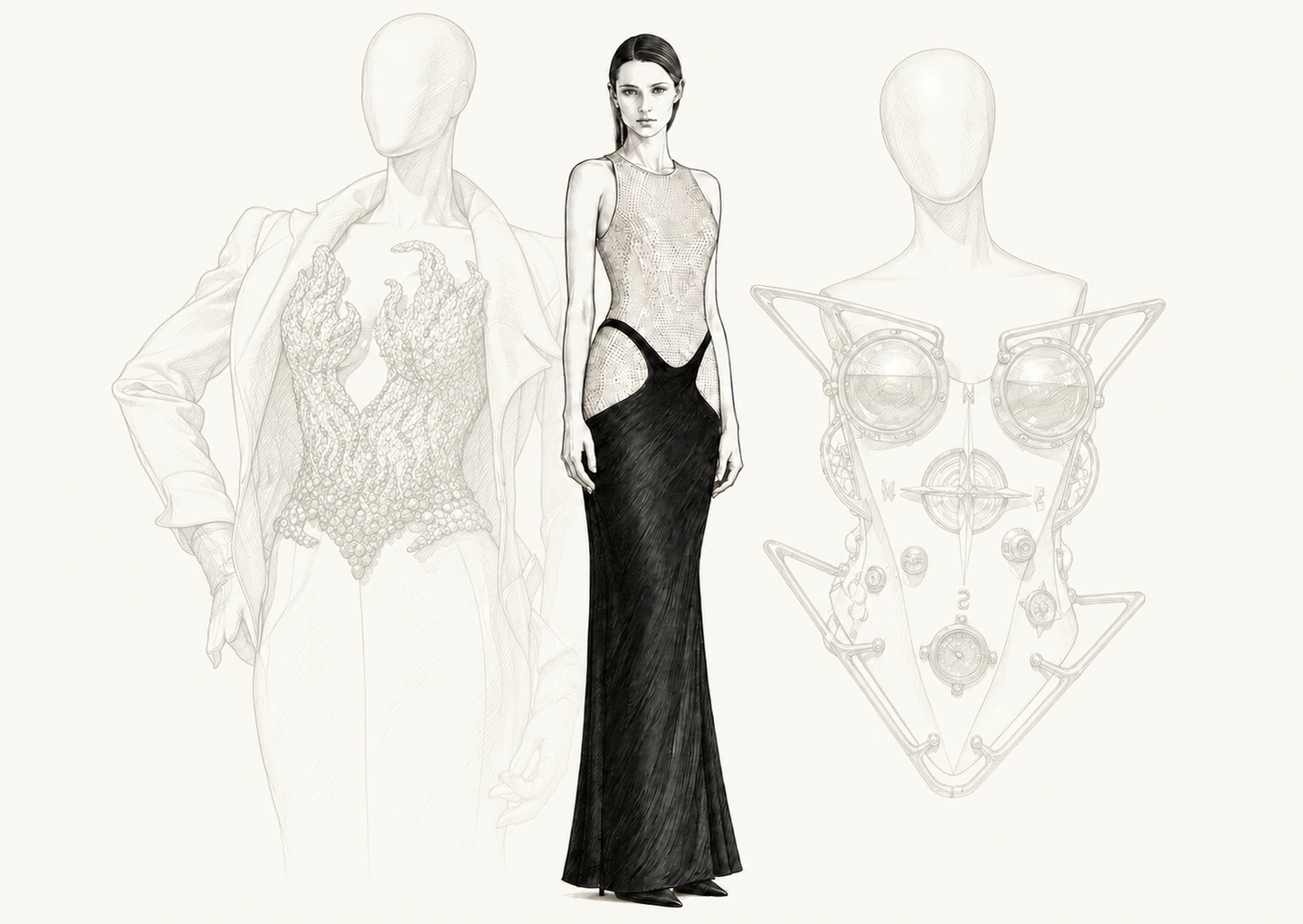
The anatomical exploration in our recent Instagram carousel comes from this relationship between clothing and the person inside it. Mugler told Vogue France that he wanted women to feel powerful and respected. He recalled androgynous characters in his shows, too, including women wearing false moustaches. His idea of power had room for theatrical disguise and pleasure in one’s appearance. Whether a tightly controlled silhouette feels liberating is something its wearer gets to decide.
Getting the creature built
Mugler took the sculpted body a considerable distance from a wool suit. His Maschinenmensch of 1995 was articulated robotic armour. Glass, Plexiglas and chrome entered the vocabulary of dressmaking. He worked with aircraft bodywork specialist Jean-Pierre Delcros and artist Jean-Jacques Urcun.
Maison Lemarié’s feather butterfly wings for Les Insectes in 1997 added another kind of specialist knowledge to his atelier. La Chimère, from autumn-winter 1997–1998, involved Urcun and corsetier Mr Pearl. Its scales and elaborate embroidery gave the figure an animal surface, with feathers and horsehair among its materials. The making of such a garment involves persistent practical problems. Its weight needs support. A rigid edge has to meet the body somewhere, and an articulated part has to move when the person inside it moves.
Those details would reward a close examination. They also give the collaborators their place in a story usually attached to a single name.
Mugler could take an equally improbable setting for a photograph. He shot advertising campaigns on the roof of the Paris Opéra and high on New York’s Chrysler Building. Against that architecture, the outline of his clothes remained readable. The height and exposure lent the figures some of the strangeness of his runway creatures.
The clothes keep circulating
George Michael’s “Too Funky” video in 1992 brought Mugler’s designs and direction to a music audience. His work for Beyoncé’s I Am… tour followed in 2009. Performers gave the clothes fresh occasions to be seen, moving through a world already crowded with images.
Angel had opened another route in 1992. The fragrance helped establish gourmand perfumery, and its star-shaped bottle could introduce someone to Mugler without a fashion show ever entering the picture. He described the fragrance, photographs and typography as parts of the same creative undertaking.
Couturissime, which opened in Montreal in 2019, assembled garments, photographs and stage work for examination together. Today, Miguel Castro Freitas, creative director since April 2025, is developing his own collections from the house’s inheritance. The Commander, autumn-winter 2026–2027, addresses power dressing. Naturalia X, his latest runway collection for spring-summer 2027, explores animal instincts and eroticism, according to the house.
The references are familiar. Their treatment through the cut remains open to invention. A shoulder can change the apparent proportions of a body within the dimensions of an ordinary jacket. That possibility gave Thierry Mugler years of work. His successor has ample reason to keep looking at it.
Sources & references
- Fondation Azzedine Alaïa: Thierry Mugler collection
- ASU FIDM Museum: Thierry Mugler
- Thierry Mugler interviewed by Tippi Hedren, Interview, 7 June 2019
- Thierry Mugler on his work, Vogue France
- Musée des Arts Décoratifs: Thierry Mugler, Couturissime
- Brooklyn Museum: Couturissime, official press dossier, 7 September 2022
- Fédération de la Haute Couture et de la Mode: Mugler
- Mugler: Naturalia X, spring-summer 2027
- Musée des beaux-arts de Montréal: Couturissime, 2019
- Mugler: The Commander, autumn-winter 2026–2027