How to Read a Cosmetic INCI List
In brief
The INCI list can help identify an allergen you need to avoid. Its order gives only partial clues about the quantities used, and tracing palm-derived ingredients may require an answer from the manufacturer.
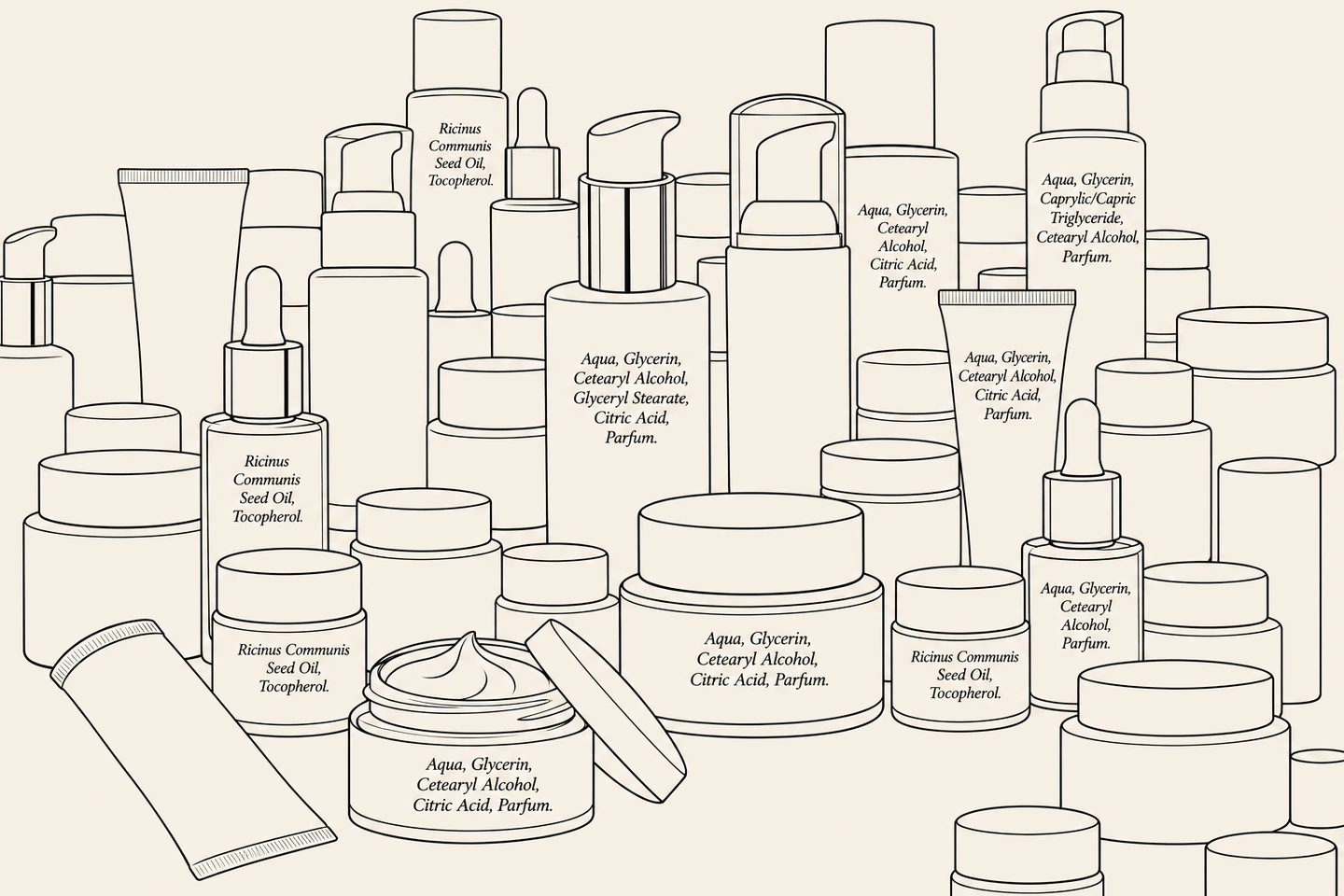
Castor oil appears on a cosmetic label as Ricinus Communis Seed Oil. Ricinus Communis names the plant and Seed Oil identifies the material used. The wording comes from INCI, the International Nomenclature of Cosmetic Ingredients, which gives manufacturers standard ingredient names. Many other entries are English. A CI code refers to a colourant; [nano] after a name indicates a nanomaterial under EU rules.
Ingredient order
On cosmetics sold in the EU, ingredients are listed by weight when added to the batch, starting with the largest amounts. Below 1%, they may go in any order after those above 1%. There are further ordering exceptions for colourants.
An ingredient present at 0.2% can therefore appear before one at 0.8%. No line on the label marks the beginning of this group. The first few names help describe the base of a product, though the order cannot give you its precise recipe.
Citric Acid may sit near the end because only a small amount is used to adjust acidity. The finished pH still needs measuring. Its position on the list cannot supply that result.
A fictional moisturiser
| Ingredient, in listed order | Common use in a cream |
|---|---|
| Aqua | Water, used as a solvent |
| Glycerin | A humectant that helps retain moisture |
| Caprylic/Capric Triglyceride | An emollient that helps soften the skin |
| Cetearyl Alcohol | Adds body and softness |
| Glyceryl Stearate Citrate | An emulsifier that helps keep oil and water mixed |
| Phenoxyethanol | A preservative that helps limit microbial growth |
| Xanthan Gum | Thickens and helps stabilise the mixture |
| Citric Acid | Adjusts pH |
| Parfum | Fragrance composition |
| Linalool | Fragrance ingredient and declarable fragrance allergen |
Cetearyl Alcohol gives body and a softer feel to many creams. It belongs to the fatty alcohols. Alcohol Denat. is denatured ethanol, used as a solvent among other functions.
A jar gets opened and touched again and again. Its preservation system has to remain suitable through that handling. Phenoxyethanol helps control microbial growth in our example. Taking it out would leave the manufacturer with the task of protecting the finished product by another suitable means.
Parabens and fragrance
The EU’s Scientific Committee on Consumer Safety judged methylparaben safe as a preservative at up to 0.4%, within the conditions it assessed. That assessment included potential endocrine effects. Isopropylparaben is prohibited in EU cosmetics.
Germany’s Federal Institute for Risk Assessment does not recommend replacing the whole family, noting their generally low allergy risk compared with some alternatives. A “paraben-free” claim leaves the choice of replacement open.
For someone sensitised to Linalool, the presence of that name matters wherever it sits. Linalool and Limonene are fragrance allergens that require individual declaration above specified thresholds. Essential oils can contain them too. A natural origin offers no assurance that the substance will suit a person allergic to it.
Since 31 July 2026, expanded individual fragrance-allergen declarations apply to products newly placed on the EU market. Older stock has a transition until 31 July 2028. A formula can stay the same while its list grows more detailed.
Palm oil and sourcing
Elaeis Guineensis Oil identifies palm oil. The Glycerin in our fictional cream could have come from palm or from another raw material. The name would remain Glycerin. Certain fatty alcohols can also have different sources under the same INCI name.
Palm-oil production has contributed to deforestation, habitat loss and damage to peatlands. WWF supports more sustainable production, including RSPO certification, and opposes a general boycott. Other oil crops may need more land to supply the same amount of oil.
Ask the brand where its palm-derived ingredients come from, and whether the certification behind its claims covers those derivatives. The information has to come from its supply chain.
The list alone cannot establish exact concentrations or the finished product’s performance. Individual reactions remain another uncertainty. Read the directions and warnings alongside it. A cleanser that is washed off involves different exposure from a cream left on the face.
Check the current pack when replacing a favourite. Its formula may have changed.
Sources & references
- DGCCRF: Understanding cosmetic labelling
- Regulation 1223/2009, Article 19
- European Commission: Preservatives
- SCCS: Methylparaben
- Commission Regulation 358/2014
- BfR: Cosmetic products: all ingredients must be tested
- European Commission: Fragrance allergens labelling
- FDA: Allergens in cosmetics
- PubChem: Cetearyl alcohol
- Cosmetics Info: Glycerin
- European Commission: Ingredient inventory
- Cosphatec: Glyceryl Stearate Citrate
- ECHA: Cosmetic preservatives
- Codibel: Sustainable palm oil
- WWF: Palm oil
- COSMILE Europe: Ricinus Communis Seed Oil
- COSMILE Europe: Alcohol Denat.